People
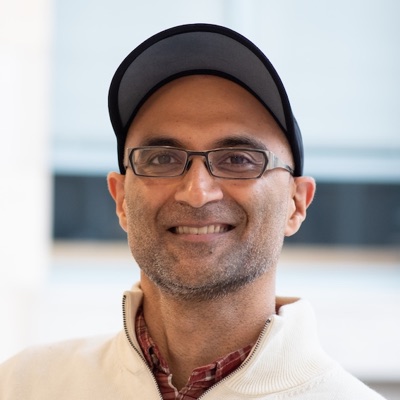
Satpreet (Sat) Singh
Assistant Professor, School of Data and Information Sciences
Before joining UNC, Sat was an Alice and Joseph Brooks Postdoctoral Fellow in Kanaka Rajan's AI + Neurotheory Lab at Harvard Medical School and the Kempner Institute. Before that, he spent a year applying AI to biology and medicine in Ankit Patel's Lab at Baylor College of Medicine and Rice University.
He received his PhD from the University of Washington in 2021, where his research bridged machine and reinforcement learning with computational neuroscience. He also holds an MS in Computer Science from Oregon State University and an MS in Electrical & Computer Engineering from the University of Iowa.
He has about five years of industry experience: as a research scientist in machine learning on Meta's Probability team, a data scientist at LinkedIn, a machine learning engineer and product manager at Orbitz.com, and a design engineer at Texas Instruments.
SDIS profile · Homepage · CV · Google Scholar · GitHub
Join us

We are building a new interdisciplinary research group at UNC Chapel Hill, open to backgrounds in ML, data science, physics, applied math, CS/engineering, neuroscience, or biology, as well as less conventional paths with relevant real-world experience. Neuroscience or biology experience is a plus but not required.
Useful strengths include computation, mathematics, scientific reasoning, experimental research, and professional communication. You don't need all of them; curiosity, initiative, and the ability to evaluate your own work matter more. Using AI tools is encouraged, but verifying their output is essential.
Interested? Please use the form instead of emailing. It takes about 15 minutes, and short answers are fine. Include a link to your CV in the form, or email it to satsingh@unc.edu after submitting. We attempt to read every submission but may not be able to reply individually.
Prospective PhD and MS students
- We are recruiting PhD students for Fall 2027 entry.
- Apply through the SDIS degree programs, such as the PhD in Data Science: apply by Dec. 15, 2026 (Dec. 1 for early funding consideration).
- Or through the Neuroscience Curriculum (via BBSP) or other graduate programs on campus. Deadlines differ by program (BBSP's are typically earlier), so please check yours.
- Prospective MS students are welcome to get in touch too. Note that the interest form does not substitute for the formal application.
Current UNC students and others
- UNC PhD, MS, and undergraduate students are welcome for research projects, rotations, or collaborations, from all majors, including pre-med.
- Undergraduates don't need prior research experience. Programming (e.g. Python) and coursework in math, statistics, or CS help, and exposure to neuroscience or biology is a plus.
- We prefer a commitment of at least one year, to allow enough time for meaningful research progress.
- We also welcome recent graduates considering graduate school (post-baccs), and others with relevant experience, including self-funded or remote researchers.
Possible project areas
- Reinforcement learning and multi-agent RL
- Embodied AI
- Emergent communication
- Agent-based models for neuroscience and biology
- Simulation engineering
- Empirical theory of neural networks (science of deep learning)
- Mechanistic interpretability
- Neural computation
- Dynamical systems analysis
- Computational neuroscience
- NeuroAI
- Neural and biological data analysis
- Program synthesis
Why UNC Chapel Hill
UNC Chapel Hill is the nation's first public university, and has ranked among the top five public universities in U.S. News & World Report for 25 consecutive years. Chapel Hill is a welcoming college town that, together with Durham and Raleigh, anchors North Carolina's Research Triangle, a hub of universities, research institutes, and technology companies.
Mentoring at previous institutions
Past mentees have been first or co-first authors at venues such as CoSyNe, CCN, and NeurIPS workshops, and have gone on to PhD programs at top institutions.
-
Ann Huang Neuroscience PhD student, Harvard · 2024–
Solution degeneracy in RNNs (NeurIPS 2025 spotlight, first author) · InputDSA (ICLR 2026, CoSyNe 2026 oral; co-first) · Curriculum learning in RL (NeurIPS 2026) · RLC 2024 workshop talk
-
Sonja Johnson-Yu CS PhD student, Harvard · 2023–
Electric fish collectives (RLDM 2025 spotlight; co-first) · Zebrafish hunting (CCN 2026; co-first) · Active sensing policies (RLC 2024 workshop talk, first author)
-
Raaghav Malik Visiting undergrad, Caltech · 2025
Zebrafish hunting (CCN 2026 proceedings, NeurIPS 2025 AI4Science spotlight; co-first)
Next: PhD, Stanford
-
Nathan Wu Neuroscience PhD rotation, Harvard · 2025
Collective fish behavior (CCN 2026; co-first) · co-author, zebrafish hunting
-
Kaden Zheng Undergraduate (senior), Harvard · co-mentored with Naomi Saphra and Sonja Johnson-Yu
Source separation for electric fish with PIKAChU and RAIChU (NeurIPS 2025 AI for Animal Communication workshop, first author)
-
Hanson Lu Visiting undergrad, Tsinghua · 2024
Emergent small-group foraging in multi-agent RL (CoSyNe 2025, first author)
Next: PhD, Brown
-
Linran (Lily) Wei Post-bac RA, Harvard · 2026–
Two NeurIPS 2026 workshop abstracts, first author: Interpretability for Discovery · Developmental Perspectives on AI
-
Raphael Suchomel Visiting undergraduate intern, University of Applied Sciences Upper Austria · Fall 2026–
Also mentored: Marco Franco (Neuroscience PhD rotation, Harvard, 2024) · Nathan Davis (undergraduate, UW CSE, 2020)
